
Your first production run worked.
The formula stayed in specification. The capsules filled correctly. Customers responded. Now you want to move from 1,500 bottles to 5,000.
Same formula. Same capsule. Same ingredient percentages.
So why should the powder behave any differently?
Because the powder does not know how many bottles you ordered. It responds to the physical conditions used to manufacture them.
A larger order can mean a different amount of powder in the blender, a different blender loading condition, different equipment, more handling, different transfer steps, or a different production environment. Not every scale-up changes all of these things. But when the process conditions change, a successful smaller run does not automatically prove that the powder will behave identically under the new ones.
There is a useful regulatory clue here. Under U.S. dietary supplement current Good Manufacturing Practice (CGMP), manufacturers must prepare and follow a master manufacturing record for each unique formulation and each batch size. FDA’s rule does not say that a larger batch is automatically more difficult. It does recognize that batch size belongs inside the manufacturing control system—not merely on the purchase order. Legal Information Institute
At PureNSM, this is one reason we pay so much attention to powder behavior. In our manufacturing experience, some sticky, fluffy, clumpy, or otherwise difficult powders may run acceptably under gentler conditions and become harder to control as production moves into more intensive automatic processing. Client_Wrighting_Video_Oskar
The important question is not simply:
Can your manufacturer make 5,000 bottles?
It is:
What changes in the process when they make 5,000 bottles—and is your powder ready for those conditions?
What Actually Changes When the Order Gets Bigger?
The bottle count is the commercial number. The powder experiences something else entirely.
It experiences a manufacturing system.
When volume increases, the manufacturer may have to change the total batch mass, blender loading, number of blending cycles, equipment route, material transfer, hopper loading, or encapsulation conditions. In some cases the same equipment and process can still be appropriate. In others, the scale-up changes enough variables that the larger run deserves its own process review.
That is why “same formula” and “same manufacturing conditions” should not be treated as interchangeable statements.
A formula tells you what belongs in the product and in what proportion.
It does not, by itself, tell you whether that powder will mix, move, feed, transfer, and fill identically at every production scale.
This distinction is especially important when evaluating a contract manufacturer. A facility can have enough theoretical capacity to produce the order while the real technical question remains unanswered:
How will this particular powder behave inside that capacity?
The first thing a brand owner should ask before scaling is therefore very simple:
“What physically changes in your manufacturing process when my order increases?”
If the answer is only, “We use a bigger machine,” keep asking.
One of the most useful follow-up questions is also one of the least glamorous:
How full will the blender be?
More Powder Doesn't Automatically Mean the Same Mixing
Powder blending is not simply a matter of multiplying every ingredient and letting the machine run longer.
How much material occupies the blender can change the way powder moves inside it.
That point has been demonstrated experimentally. In a pharmaceutical ribbon-blender study, researchers changed the loading pattern, blender fill percentage, rotational speed, and mixing time. Among those variables, fill percentage was the most influential mixing parameter in that study. At the highest rotational speed tested, the intended blending endpoint was not reached—an important reminder that “faster” does not automatically mean “better mixed.” PubMed
The business implication is straightforward.
If increasing your order changes the blender loading condition, the manufacturer should understand whether the same mixing approach is still appropriate rather than simply scaling ingredient weights and assuming the earlier settings remain valid.
That does not mean every larger batch requires a new formulation or complicated development program. It means the process should be understood rather than assumed.
Useful questions include:
- Will the larger order use the same blender?
- Will the blender fill level change?
- Will one larger blend be made, or several separate blends?
- How are mixing time and operating parameters established for this batch size?
- What tells the manufacturer that the blend is ready to move to encapsulation?
But even correct blending is not the end of the story.
The powder still has to leave the blender, move through the rest of production, and arrive at the capsule-filling mechanism without undoing the uniformity that was just created.
The Blend Was Uniform. What Could Separate It Again?
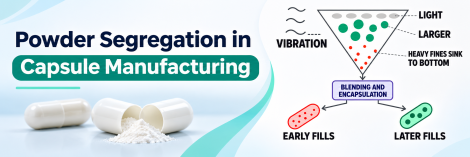
A blend can be uniform when mixing ends and still be susceptible to segregation later.
That is one of the most important scale-up ideas for a brand owner to understand.
After blending, powder may still be discharged, transferred, loaded into a hopper, vibrated, fluidized, or fed through downstream equipment. Pharmaceutical manufacturing research has shown that initially mixed powders can segregate during later processing and that the risk depends on the physical properties of the blend and the stresses it experiences. PubMed
In other words:
Uniform once does not automatically mean uniform through the entire process.
That matters because a capsule manufacturer does not sell you a uniform blender.
They sell you finished capsules.
The blend must remain controlled long enough for those capsules to be filled consistently.
PureNSM’s current scale-up thinking comes from that manufacturing reality. In Oskar’s working material, the concern is not simply whether ingredients were weighed correctly. It is what happens when powders with different physical characteristics are exposed to automatic production, movement, friction, and vibration.
Particle Size Is Part of the Formula's Manufacturing Behavior
Particle size matters because particles with different physical characteristics do not always move together in exactly the same way.
Research on pharmaceutical blends has shown that particle-size differences can influence segregation potential, especially when the blend is exposed to disturbances such as vibration or fluidization. PubMed
That does not mean every blend with multiple particle sizes will separate.
It means the manufacturer should understand whether the differences are large enough, and the formulation sensitive enough, to create a problem under the actual production conditions.
For a brand owner, that turns an abstract technical term into a practical question:
“How do you evaluate whether the particle-size differences in my blend could affect uniformity during transfer or filling?”
Density Matters—but It Isn't the Whole Story
It is tempting to reduce powder segregation to one simple rule: heavy particles sink and light particles rise.
Real powder systems are more complicated.
Particle size, density, shape, cohesion, fines, flow behavior, and the type of physical disturbance can all influence what happens. In one study designed to mimic manufacturing stresses, segregation behavior changed depending on particle sizes and whether the blend experienced vibration or fluidization. PubMed
That is why a manufacturer should not approach every formula with one universal explanation or one universal correction.
The right question is not:
“Do powders segregate?”
It is:
“Is this powder susceptible to segregation under this process?”
And that brings us to another important point: some powders give a manufacturer far more trouble than others.
Sticky, Fluffy, Clumpy: Why “Same Formula” Can Still Feel Different on the Line
A formula may be perfectly legitimate on paper and still be difficult to manufacture.
Some powders are low-density and fluffy. The same weight can occupy more volume than expected, making the target fill harder to fit into the selected capsule.
Some are sticky or resin-rich and do not move easily through equipment.
Some clump.
Some build static and cling where the manufacturer needs them to move.
Others contain ingredients with different particle sizes or densities that increase the potential for uneven movement during handling.
These are not all the same problem, and they should not receive the same automatic solution.
PureNSM’s current encapsulation materials identify sticky, resin-like, low-density, and static-prone powders as examples of materials that may require conditioning before encapsulation. The company describes evaluating the material first and applying the mechanical processing appropriate to the powder rather than using one process for every formula. Encap page OMT with Sultan Feed…
The consequences are practical.
Poor flow can create uneven feeding into encapsulation equipment. Capsule-filling research has found significant relationships between powder flow characteristics and filled-capsule weight variability. PubMed
Low density can create a different problem: too much volume for the required dose.
Sticky or clumpy powder can interfere with predictable movement and slow the process.
The details differ, but the buyer’s question is the same:
“What physical powder properties are you evaluating before you schedule the larger run?”
A COA Can Confirm the Ingredient Without Predicting How It Will Flow
A Certificate of Analysis (COA) is important. It can address defined analytical specifications such as identity, purity, potency, or other tested characteristics depending on the ingredient and method.
But those answers are not the same as asking how the material will behave physically inside production equipment.
A powder can meet its analytical specifications and still arrive with different density, moisture, particle-size distribution, cohesiveness, or flow behavior.
That distinction is especially relevant with botanicals.
Same Botanical, Different Physical Behavior
In PureNSM’s manufacturing experience, the same botanical or extract can arrive with different physical characteristics from one incoming lot to another. Oskar’s working notes describe examples where a material still receives the expected botanical identity result but arrives significantly fluffier, stickier, or more clumped than a previous lot. Client_Wrighting_Video_Oskar
That does not mean the ingredient is automatically wrong.
It means analytical identity and physical manufacturability answer different questions.
For a growing brand, this creates another scale-up issue that is easy to miss: a larger production run may require more raw material and potentially additional incoming lots. Previous manufacturing settings should not be treated as proof that every future material lot will behave identically.
So what happens when the powder is difficult?
That is where manufacturing capability becomes more meaningful than machine capacity.
What Can a Manufacturer Actually Change When the Powder Won't Cooperate?
A manufacturer cannot control every natural difference in incoming powder.
What matters is what the manufacturer can do when the material does not behave as expected.
PureNSM has invested in several powder-conditioning processes for this reason, including dry granulation through roller compaction, wet granulation, milling, fluid-bed drying, automatic sifting, and particle-size/flow optimization. Encap page OMT with Sultan Feed… PureNSM’s current website describes these same processes as part of its encapsulation and granulation capabilities. Nutritional Supplement Manufacturers
Dry granulation, for example, can compact a low-density powder into a denser mass and then mill that material into more manageable granules. PureNSM describes roller compaction as increasing bulk density and improving flow for appropriate materials. Nutritional Supplement Manufacturers
Wet granulation approaches the problem differently. A liquid binder is used to agglomerate fine material into larger granules, after which the material is dried and sized. PureNSM uses a fluid-bed dryer as part of this process where appropriate. Nutritional Supplement Manufacturers
Milling and sifting can then help control the resulting particle-size distribution.
The important word throughout that explanation is:
Appropriate.
Granulation is not automatically required because an order grew.
A powder should not be processed simply because the equipment exists.
Equipment Matters Only When It Solves the Right Powder Problem
A machine list tells you what equipment is in the building.
It does not tell you whether the manufacturer understands which problem that equipment should solve, when it should be used, or when it should be left alone.
That distinction is central to Oskar’s manufacturing point of view.
The equipment matters because of the problem it can solve:
- roller compaction may help densify appropriate powders;
- wet granulation may help create more manageable granules from difficult material;
- milling can change or control particle size;
- sifting can help manage particle-size distribution;
- drying may be required after wet processing.
The expertise is in matching the process to the powder.
Granulation Is a Tool—not a Default Answer
This is also where scale-up becomes a commercial decision.
Conditioning adds manufacturing steps. Additional steps can affect time and cost.
But forcing a poorly behaving powder through production can also reduce throughput, cause interruptions, require troubleshooting, or create consistency problems.
The right goal is not maximum processing.
It is enough processing to make the powder behave appropriately for the product and the production system.
That changes the way a buyer should ask whether a contract manufacturer can “scale.”
Production Capacity Is Easy to Quote. Process Readiness Is Harder to Prove.
“Can you make 5,000 bottles?” is a capacity question.
It is not yet a scale-up question.
A better discussion sounds more like this:
What changes in your process at this quantity?
Does the larger run use the same blender, the same loading condition, and the same encapsulation route?
How do you decide the mixing conditions for the larger batch?
You want to know that the production parameters are established deliberately rather than copied without thought from a different scale.
What physical powder properties matter for my formulation?
Flow, density, particle-size distribution, cohesiveness, moisture, or another variable may matter depending on the product.
What happens if the incoming raw material behaves differently from the previous lot?
A manufacturer should be able to explain how an unexpected physical change is evaluated.
What can you correct in-house?
If the powder requires granulation, milling, drying, or sifting, is that capability available at the same facility, or must the material leave the plant?
How do you think about segregation after blending?
The question is not merely whether the blender can produce a uniform blend but whether that uniformity can be maintained through downstream handling.
What tells you the larger run is under control?
Ask about applicable in-process specifications, monitoring, testing, and documented acceptance criteria.
“We Have Capacity” Is Not a Complete Answer
Capacity tells you how much equipment can theoretically produce.
Process readiness tells you whether your particular material can be manufactured predictably under the conditions used to create that volume.
Those are different questions.
A 10-million-capsule machine does not automatically solve poor flow.
A larger blender does not automatically solve segregation.
More speed does not automatically improve mixing.
The buyer should therefore understand the production route, not simply the headline capacity.
The Production Record Matters More Than the Sales Promise
FDA requires a batch production record each time a dietary supplement batch is manufactured, and that record must contain complete information relating to production and control of the batch and follow the applicable master manufacturing record. Legal Information Institute
Required batch-record information includes items such as the equipment and processing lines used, component quantities, actual yield, monitoring results, and results of testing or examination performed during production. GovInfo
That turns “trust us” into much more specific due diligence.
A brand owner can ask:
- What does the batch record document for my production run?
- Which equipment and processing lines will be identified?
- What monitoring occurs?
- What tests or examinations are documented?
- What happens when a relevant specification is not met?
This is not about micromanaging the factory.
It is about understanding whether scale-up is being controlled as a manufacturing process rather than treated as a larger purchase order.
And FDA’s master-record requirement makes that distinction even clearer.
FDA Doesn't Treat Batch Size as Just a Purchase Quantity
Under 21 CFR §111.205, a dietary supplement manufacturer must prepare and follow a written master manufacturing record for each unique formulation and each batch size. That master record must identify the points, steps, or stages where control is necessary and establish procedures designed to ensure that the batch meets the relevant specifications. Legal Information Institute
FDA also requires manufacturers to establish specifications at manufacturing steps where control is necessary to ensure the quality of the dietary supplement. For in-process production, specifications are required where necessary to help ensure identity, purity, strength, composition, and appropriate contaminant limits are met. eCFR.io
None of that means FDA has declared large batches inherently less safe.
The lesson is more useful than that:
Batch size belongs inside the controlled manufacturing process.
For the buyer, that creates three particularly good questions:
- Is there a master manufacturing record for the batch size being proposed?
- Which in-process specifications matter for this product?
- What will the batch production record show about how the run was actually executed?
Those questions help separate a manufacturer that simply has enough capacity from one that can explain how your product will be controlled at that scale.
The Real Scale-Up Question Was Never the Bottle Count
Return to the original question.
Your brand moved from 1,500 bottles to 5,000.
Will the powder behave the same?
It might.
If the relevant manufacturing conditions remain appropriate and the powder remains well controlled, there is no reason to assume that growth automatically creates a problem.
But that is precisely the point.
The answer should come from understanding the process—not from assuming that a formula that worked once must behave identically everywhere.
When production volume increases, ask what changes in the manufacturing conditions. Ask what the manufacturer checks. Ask how the powder’s flow, density, particle characteristics, and tendency to segregate are considered when relevant. Ask what happens if the next lot behaves differently. Ask what processing options exist if the material needs help. Ask what the batch record will document.
The most useful definition of a scalable manufacturer is therefore not:
“They have a big machine.”
It is:
They understand how the powder and the process interact as production changes—and they have a way to respond when the material does not behave as expected.
PureNSM evaluates difficult powders and maintains in-house capabilities including dry and wet granulation, milling, fluid-bed drying, sifting, and other powder-conditioning processes for formulations that need them. Nutritional Supplement Manufacturers
Growth should increase your production volume.
It should not decrease the amount you understand about how your product is being made.
If you are preparing to increase production, discuss the formula, powder behavior, and manufacturing route with PureNSM before the larger batch is scheduled.
Frequently Asked Questions
What is powder segregation in capsule manufacturing?
Powder segregation occurs when components that were previously mixed begin separating during handling or processing. Differences in particle size, density, flow behavior, and process conditions can contribute depending on the formulation.
Is poor powder flow the same as powder segregation?
No. Powder flow describes how readily material moves through equipment. Powder segregation describes whether different components remain distributed within the blend. A formulation can experience one problem, the other, or both.
Can vibration cause powder segregation?
Vibration can contribute to segregation in susceptible powder blends, particularly when physical differences between particles allow them to move differently. The effect depends on the formulation and manufacturing conditions.
Can granulation reduce powder segregation?
Granulation can help reduce segregation risk in suitable formulations by changing how particles are physically associated and behave during processing. It is not a universal solution, so the manufacturer should first evaluate what is causing the problem.
Why can a powder behave differently at a commercial scale?
Commercial manufacturing can introduce additional transfer, feeding, vibration, machine interaction, and longer processing conditions. Those changes can reveal flow or segregation tendencies that were less obvious during smaller-scale work.