
Cut the Plastic. Keep Your Market Share.
Around 85% of supplement brands are already reducing plastic packaging — or actively planning to. The brands that move first won’t just cut waste, they’ll keep their name in the customer’s hands long after the sale.
That’s what our Refill & Reorder system is built for. PureNSM and ENCAP North America teamed up to give brands a packaging model that removes plastic without giving up shelf presence, reorder revenue, or GMP-grade quality control.
Why Plastic Is a Problem Worth Solving
The supplement industry ships a lot of plastic, and most of it doesn’t go anywhere good.
It doesn’t break down — it breaks apart. A plastic bottle doesn’t decompose the way an apple core does. It takes roughly 450 years to fully disappear, and along the way it just fragments into smaller and smaller pieces — microplastics and nanoplastics that never fully go away.
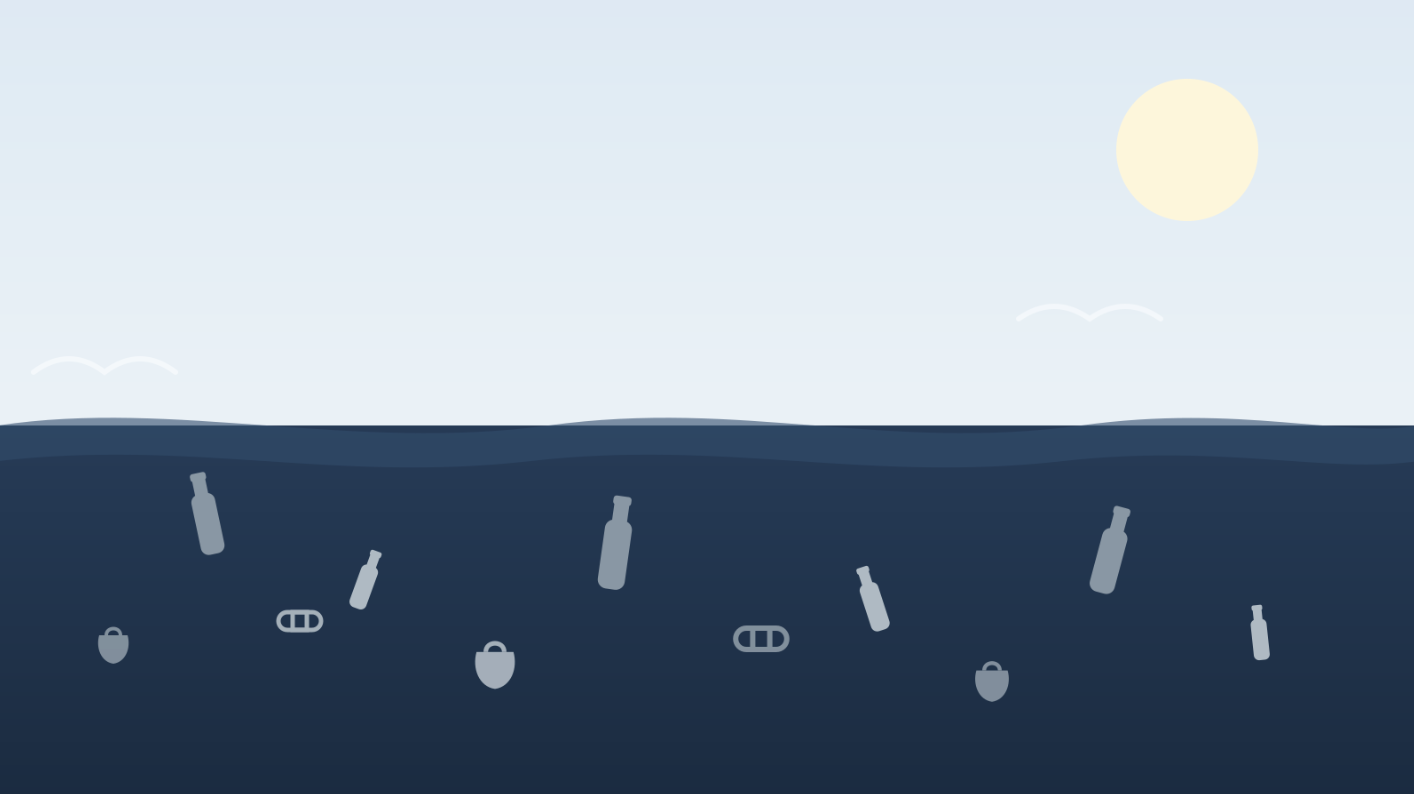
Almost none of it gets recycled. Of all the plastic ever produced, only about 9% has been recycled. The rest is burned, buried in landfill, or ends up in the environment — including the roughly 11 million tonnes that enters the ocean every year, the equivalent of a garbage truck’s worth of plastic dumped into the sea every 30 seconds.
It’s already inside us. Microplastics have been found in human blood, lungs, livers, hearts, and even placentas. Researchers have linked more than 4,000 plastic-related chemicals to health concerns, including known endocrine disruptors. Over a third of the fish caught for human consumption now test positive for plastic.
It’s a climate cost, not just a waste problem. Producing one tonne of new plastic generates roughly 2.5 tonnes of CO2 — emissions that happen before a single bottle ever reaches a shelf, on top of whatever it costs to ship, use, and eventually try to dispose of it.
Wildlife pays first. More than a million seabirds and roughly 100,000 marine mammals die every year from plastic in their habitat — mistaking it for food or becoming entangled in it.

It’s a public health bill, not just an eyewash statistic. Plastic-related chemical exposure is now linked to an estimated $1.5 trillion in health costs a year across just 38 countries studied — covering conditions from heart disease and stroke to cancers, asthma, and birth complications. Researchers have flagged roughly 4,200 plastic-associated chemicals as hazardous, with nearly 1,500 classified as carcinogenic or mutagenic.
Burning it doesn’t make it disappear either. Where plastic waste isn’t landfilled, much of it is burned — and incineration and open burning release toxic fumes that put landfill workers and nearby communities at direct, ongoing risk, on top of the emissions already baked into making the plastic in the first place.
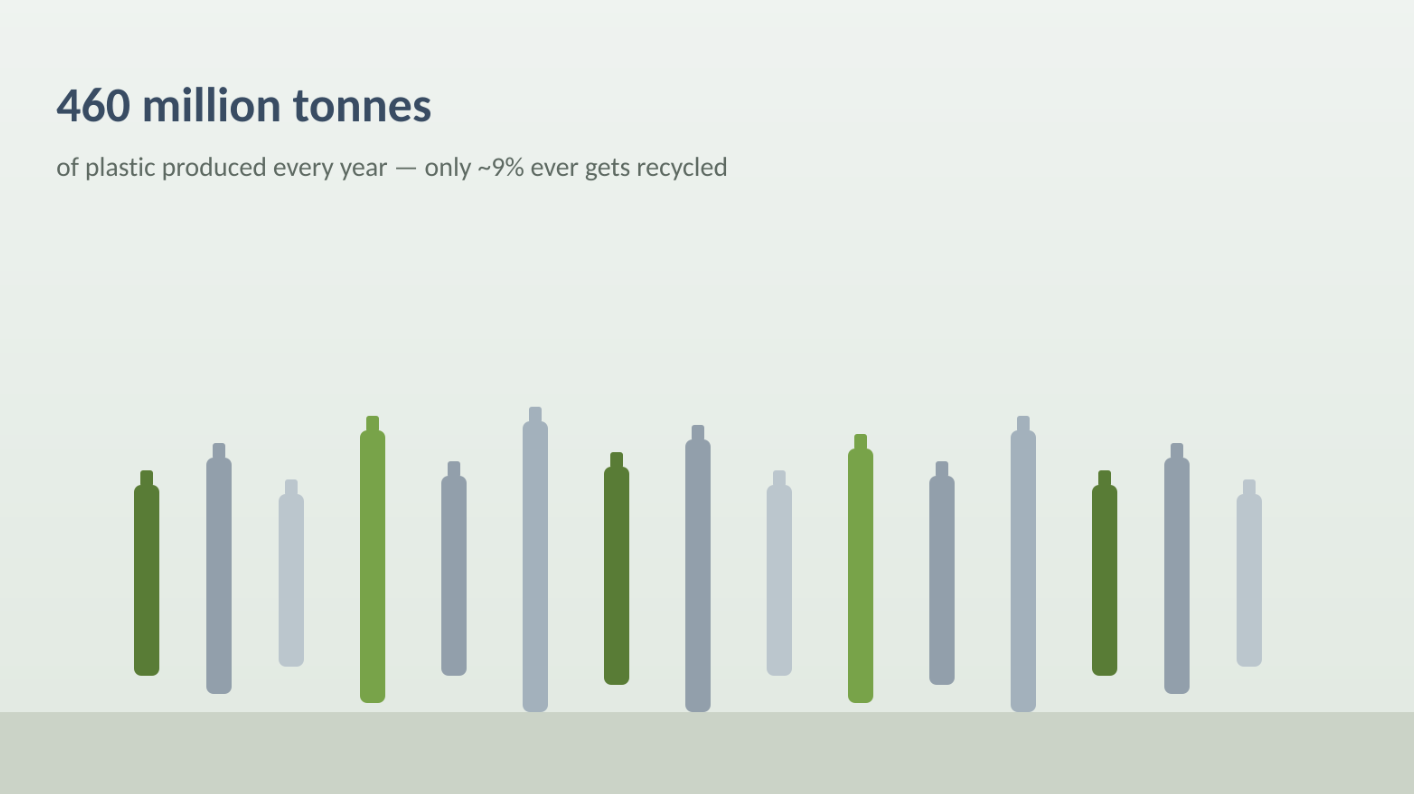
It’s on track to get worse, fast. Global plastic production has already grown from 2 million tonnes in 1950 to roughly 460 million tonnes today, and it’s forecast to more than double again — past 1.2 billion tonnes a year by 2060 — unless the packaging habits driving that curve actually change.
Someone has to pay to clean it up. Plastic waste cleanup and management already cost an estimated $361 billion a year worldwide, a bill that falls disproportionately on public budgets rather than the companies producing the packaging.
Every bottle a customer refills instead of throwing away is one less bottle added to that pile. At scale, across a subscription base reordering month after month, that adds up fast — and it’s the whole reason we built a system designed to keep the same bottle in circulation instead of manufacturing a new one every time someone reorders.
How It Works
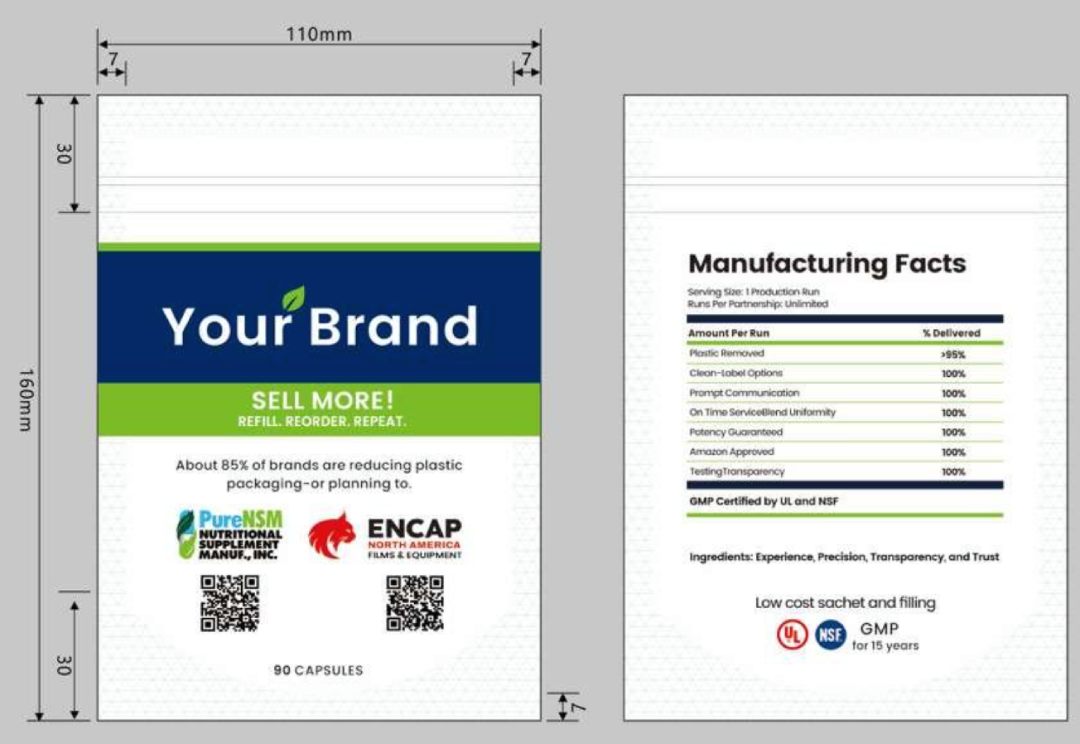
Ship less plastic, sell more product. A single reusable, branded bottle goes out once. After that, customers refill it straight from a low-cost sachet — no new bottle, no new cap, no repeat plastic footprint.
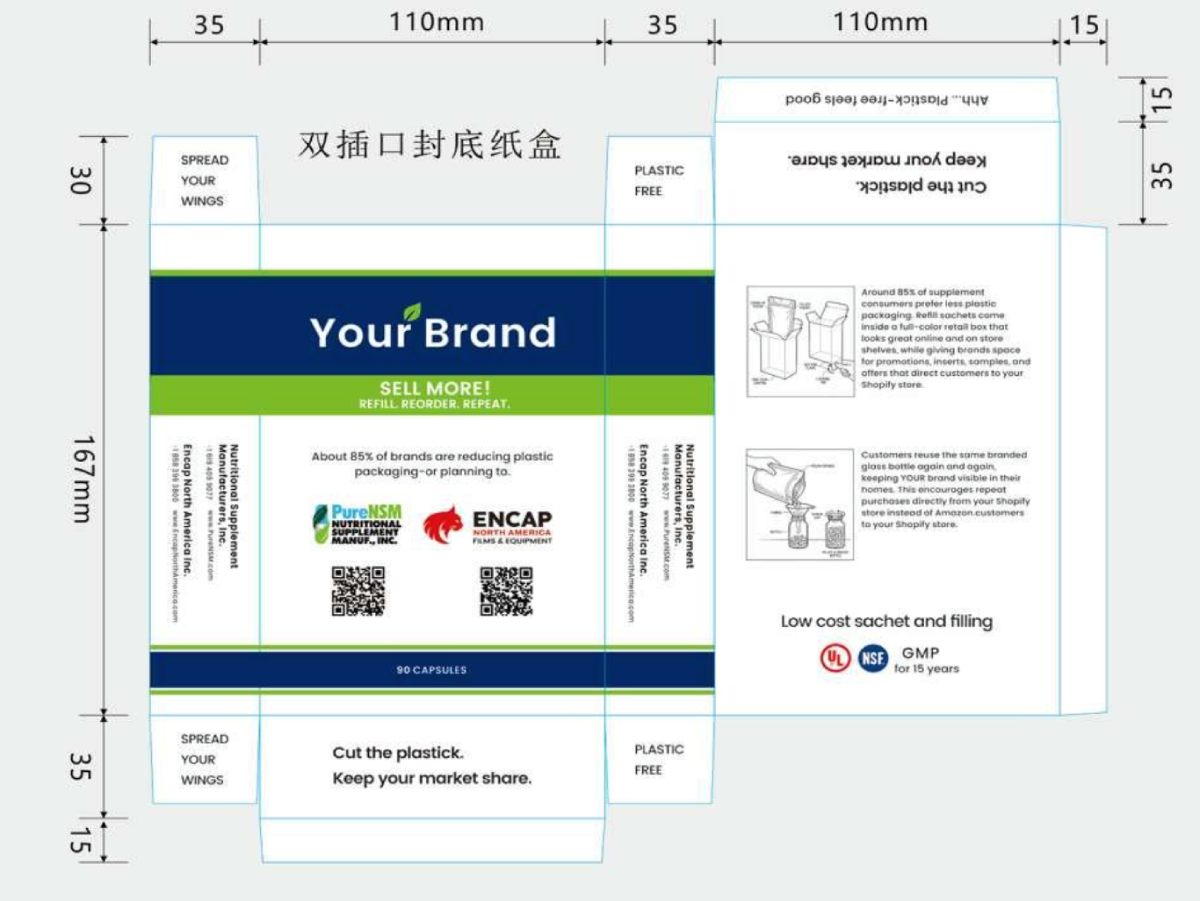
The refill sachet. Comes packed inside a full-color retail box that looks just as good on a store shelf as it does online, with room left over for promotions, inserts, samples, and offers that pull customers back to your own Shopify store instead of Amazon.
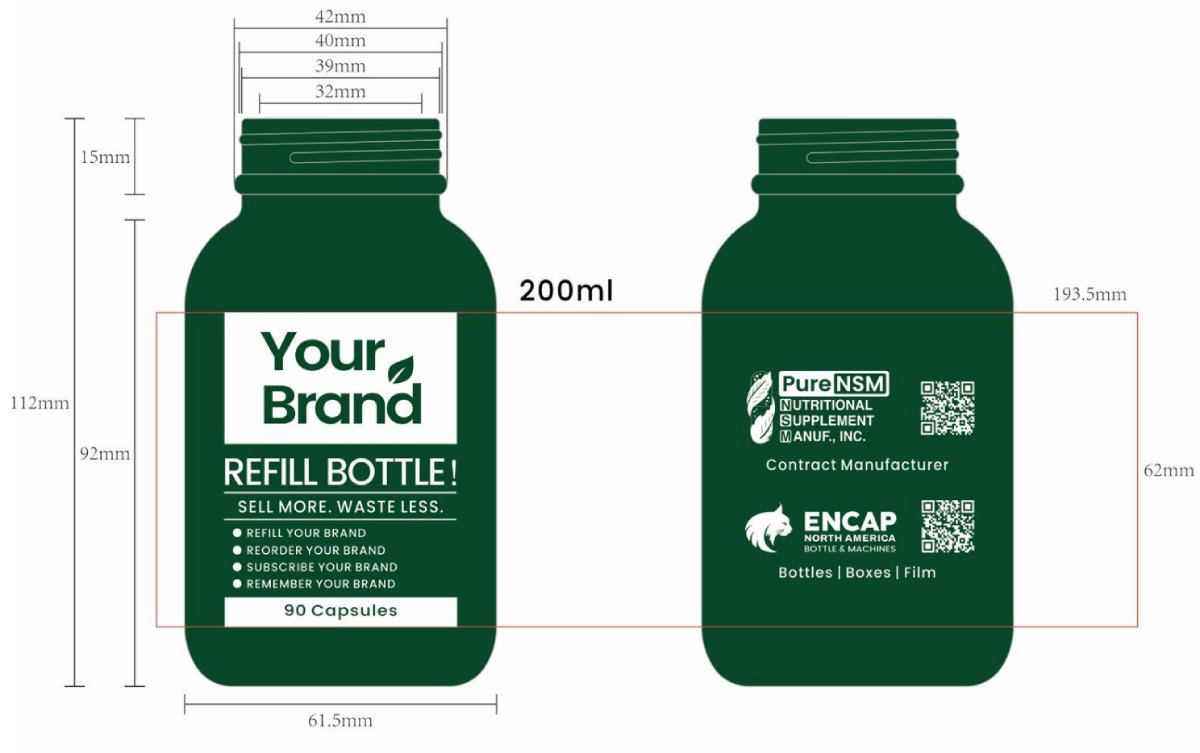
The reusable bottle. Customers keep and refill the same branded bottle order after order, so your logo stays visible on their counter—a constant reminder to reorder directly, not to search for you on a marketplace.
Ahh… plastic-free feels good. For the customer, it’s a lighter footprint. For the brand, it’s a direct line back to repeat purchases.
Manufacturing Facts
Every run is held to the same standard, printed right on the packaging:
Plastic Removed | > 95% |
Clean-Label Options | 100% |
Prompt Communication | 100% |
On-Time Service & Blend Uniformity | 100% |
Potency Guaranteed | 100% |
Amazon Approved | 100% |
Testing Transparency | 100% |
GMP Certified by UL and NSF — 15 years running.
Built for Brands That Want to Keep Their Market Share
This isn’t packaging for packaging’s sake. It’s a system: refill sachets that cost less to ship and produce, a reusable bottle your customers hold onto, and a supply chain — PureNSM for formulation and manufacturing, ENCAP North America for bottles, boxes, and film — that backs every run with the same testing transparency and potency guarantees your brand is built on.
Spread your wings. Cut the plastic. Keep your customers coming back.
Frequently Asked Questions
What is the Refill & Reorder system?
It’s a plastic-reduction packaging model built by PureNSM and ENCAP North America: a customer receives one reusable, branded bottle, then reorders low-cost refill sachets instead of a full new bottle and cap every time — cutting more than 95% of the plastic used per reorder.