

Encapsulation Services for Supplement Brands
Potency Isn’t Optional
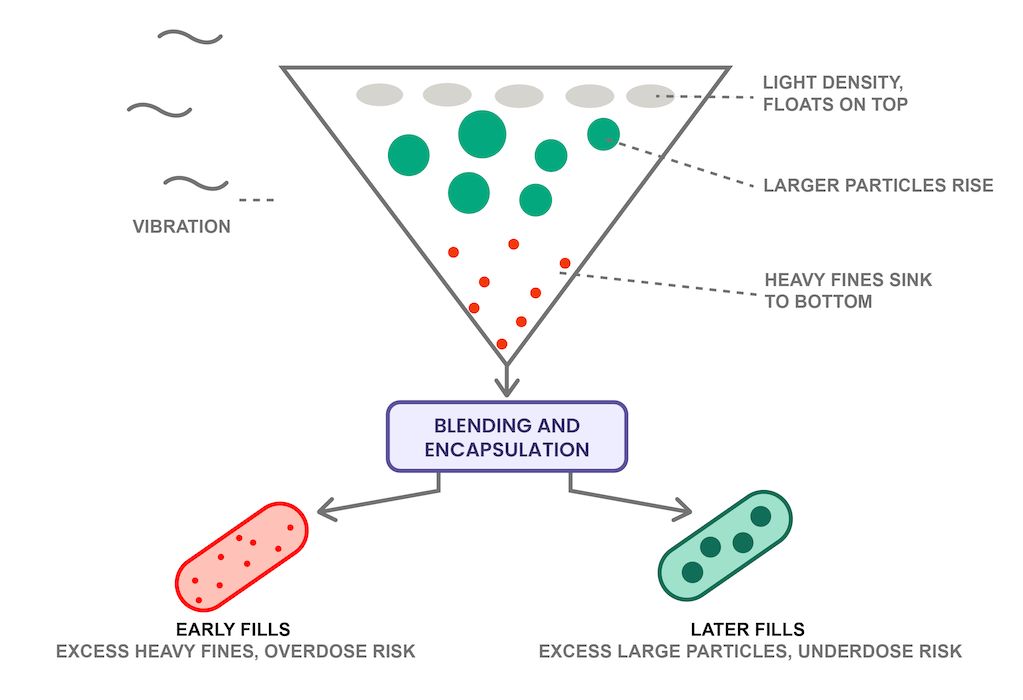
Reliable potency and consistent fill weight are simply impossible to achieve at scale without the mechanical engineering of your powder’s particle size. Many CMOs hit a wall right here, and the consequences aren’t hypothetical: sticky, clumping, and fluffy powders often run fine on gentle semi-automatic equipment, then stumble the moment they hit a fully automatic encapsulation machine, where friction, speed, and constant vibration segregate the blend by particle size and density.
Fluffy material rises, denser powder sifts down, and potency ends up different at the beginning of a batch than at the end—even though every ingredient was weighed correctly and the powder looks fine the whole time. This isn’t a cosmetic issue. It’s exactly the kind of variance Amazon tests for and pulls listings over.
We remove the risk at its source. We’ve invested in roller compactors, wet granulation, milling, and auto-sifting equipment specifically to bring every ingredient to a matched, uniform particle size before blending—so there’s nothing left for vibration to sort. The same engineering that protects your potency is what lets our fully automatic machines run at good speed, bringing cost per capsule down and passing that savings on to you. The blend that goes into the hopper is the blend that enters the capsules, capsule after capsule, letting you reliably scale from semi-automatic runs to full commercial volume on fully automatic encapsulation machines.
Scale with PureNSM
Powder Conditioning for Consistent Potency & Fill
- Roller Compactor
- Wet Granulator
- Milling
- Auto-Sifter
Economical Clean-Labels
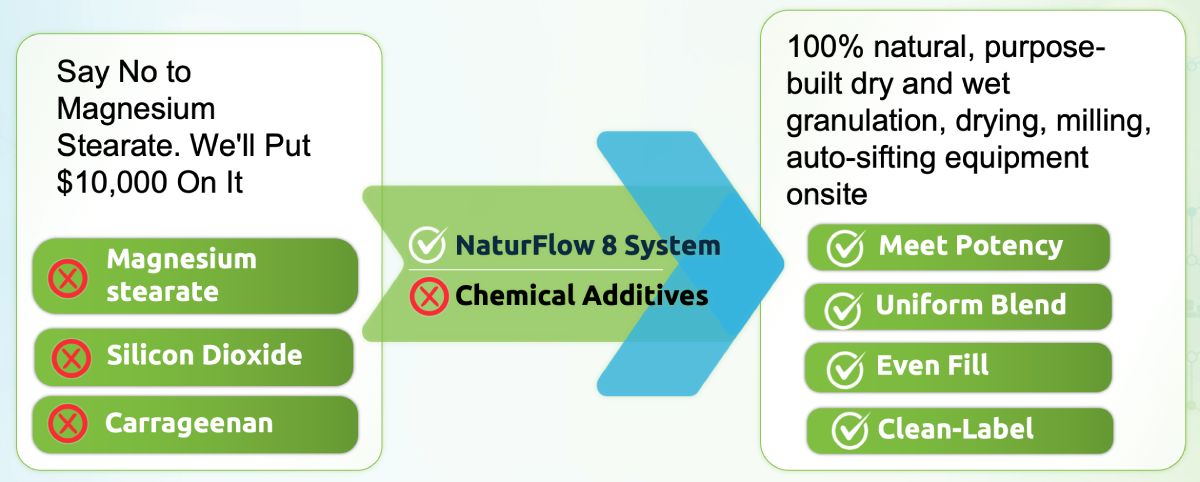
- Alternatives to Magnesium Stearate
- 100% Natural
Economical Clean-Packaging
- 85% Reduction of Plastic
It has become evident that many consumers don’t like magnesium stearate. While we love encapsulating powders that contain it because it makes our jobs easier, we have been able to find alternatives. Have us evaluate your formulas to free your brand of magnesium stearate. We have been doing this since 1993 and know more about this than most.
Have us take a look at your formulas. It may be easier than you think to free them from magnesium stearate.
Powder Conditioning for Consistent Encapsulation
Not every powder behaves the same way on an encapsulation line. Some powders flow easily; others are sticky, resin-like, low-density (“fluffy”), or prone to static—and botanical density can shift from lot to lot even within the same formula. Left untreated, these powders resist even flow through encapsulation machines, leading to inconsistent fill weights and failed potency tests. Consistent fill weight will also become a problem between lots.
PureNSM uses specialized powder conditioning techniques—including granulation, milling, and particle-size correction—to improve flow, density, and blend uniformity before a powder ever reaches the encapsulation machine. We evaluate every powder first, then apply the mechanical conditioning it actually needs, rather than defaulting to a one-size-fits-all process.
Types of Containers
Packaging is crucial. We find that plastic is gradually going to face out and packing into sachets is going to become the standard. We pack in all sorts of containers, including glass jars
- Plastic Supplement Bottles: The most common
- Paper Supplement Bottles
- Supplement Sachets: This option reduces plastic by 85%. We pack any amount of capsules into sachets and then put the sachets into a full color retail box.
- Glass Bottles
- Bulk: Perhaps you want to pack it
Types of Capsules We Manufacture
- Two-piece hard-shell capsules in gelatin, vegan/HPMC, and tapioca options
- Powder-filled capsules for botanicals, vitamins, minerals, and blended formulas
- Oil-filled capsules for liquid and oil-soluble actives
- Liposomal and cyclodextrin-complexed capsules are especially effective for hydrophobic or oil-based actives requiring advanced absorption technology
Ingredients We Commonly Encapsulate
PureNSM formulates and encapsulates a wide range of ingredient categories, including:
- Botanicals and herbal extracts
- Vitamins and minerals
- Amino acids and protein blends
- Probiotics
- Oil-soluble actives, including liposomal and cyclodextrin-complexed formulations
Each ingredient category requires its own identity and potency verification method — see Quality Testing & Potency Verification below.
Our Powder Conditioning Process
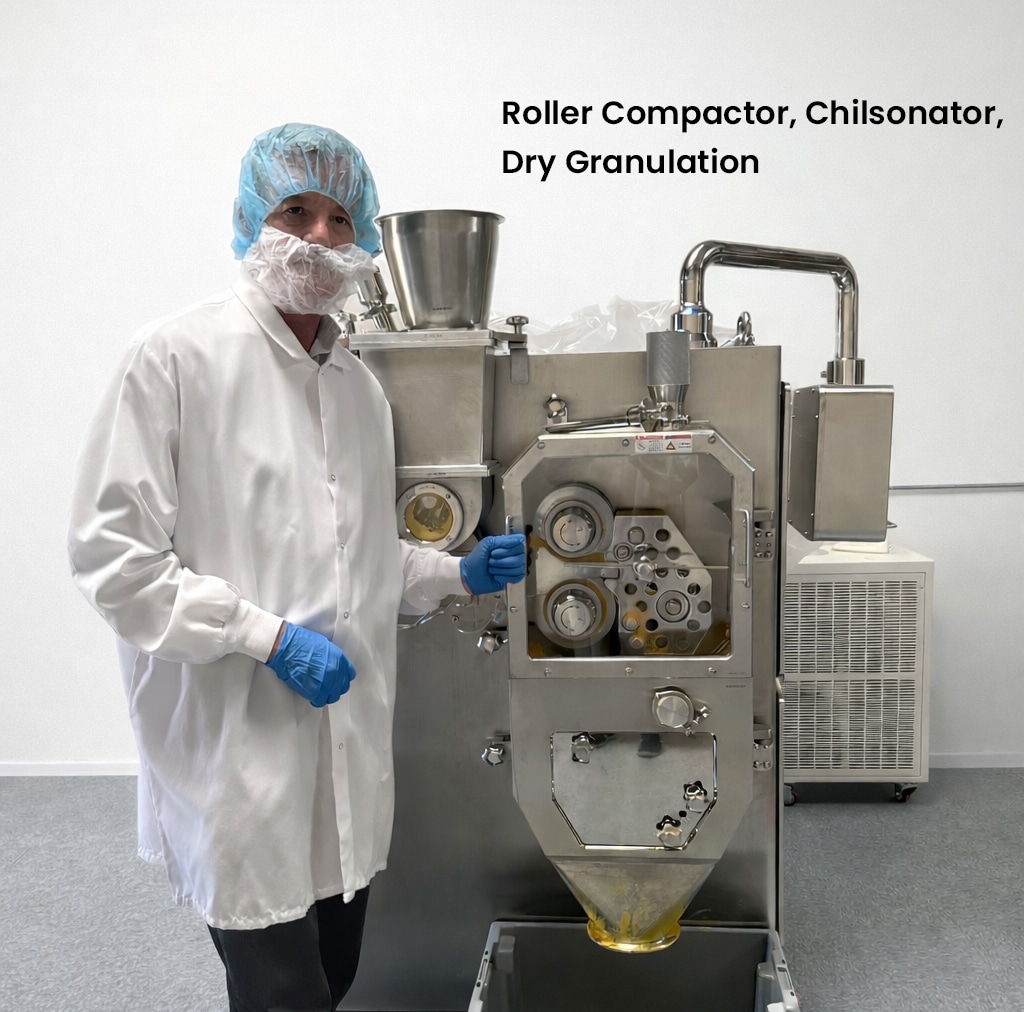
- Dry granulation (roller compaction): Compresses powder under high pressure into a solid mass, with no added moisture or heat, then mills it into uniform granules. Ideal for heat- and moisture-sensitive actives.
- Wet granulation: A liquid binder is added gradually to bind particles together; the wet mixture is dried in a fluid-bed dryer, then sieved to a consistent size. A strong option when a sticky blend also needs better compressibility. Freeze-drying is also available.
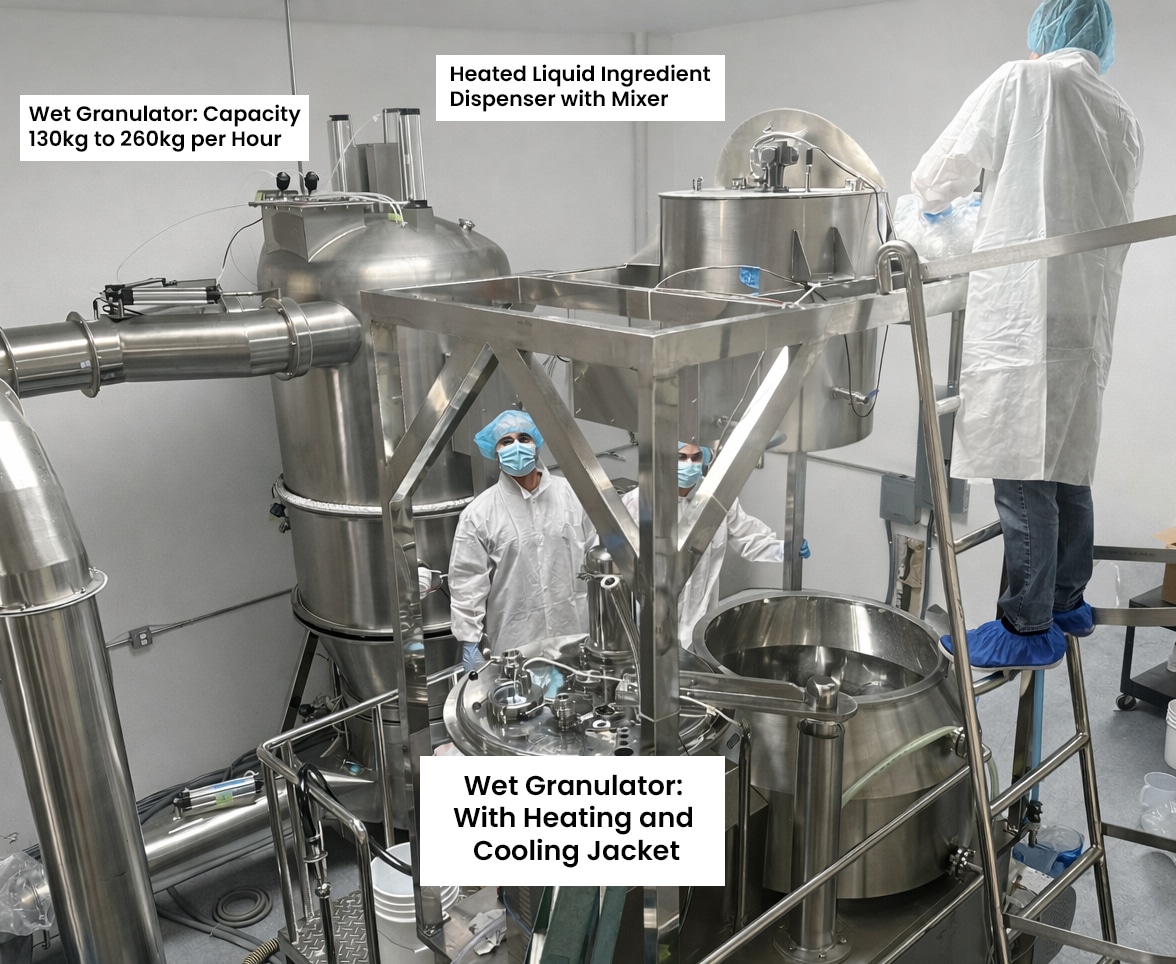
- Milling: Reduces particle size and produces uniform granules following either granulation method.
- Automatic Sifting: Sifting to 80 mesh
- Particle-size control: Matches particle sizes across different raw materials in a formula, which is critical to an even, potency-consistent blend.
- Flow optimization: Mechanical conditioning that improves how a powder moves through encapsulation equipment.
- Natural flow-agent options: Including rice extract, bamboo extract, and other natural alternatives to magnesium stearate.
All powder conditioning is performed on-site through PureNSM’s proprietary NaturFlow8 System.
Quality Testing & Potency Verification
Most supplement brands that fail a potency test fail for the same reason: an uneven blend, not a bad formula. When active ingredients aren’t distributed evenly through a powder, some capsules end up above label claim and some below it — the inconsistency that gets products pulled from Amazon and other retailers.
PureNSM addresses potency in five steps:
- Evaluate the powder first — testing for identity, purity, and potency before any blending or filling begins, to determine what mechanical conditioning is needed.
- Correct particle sizes through in-house granulation — ensuring raw materials are matched in particle size for an even blend.
- Calculate overages — adding the precise amount of extra active ingredient needed so the product still meets label claim through the end of shelf life.
- Fill and friction test — a slug fill test and, when warranted, a friction test, used to fine-tune the formula before full production.
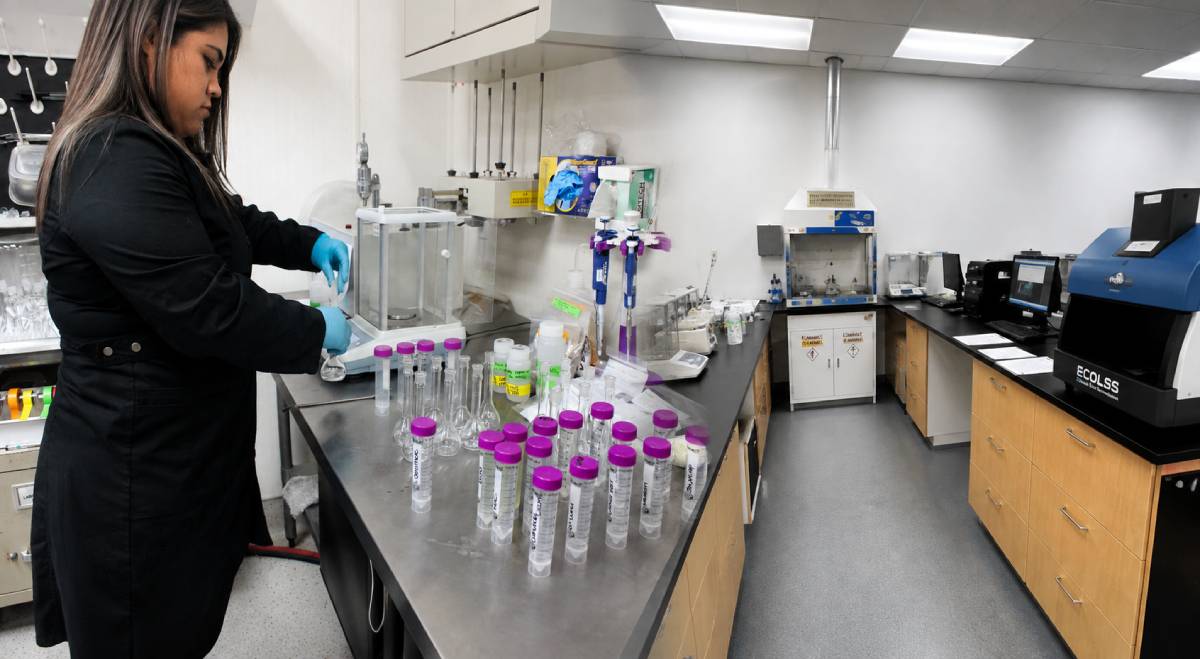
- Test everything in-house — using HPTLC (botanical identity, tested on 100% of incoming botanicals), FTIR (vitamin identity), HPLC (potency and identity), and ICP-MS (heavy metals). All raw materials are also tested in PureNSM’s BSL-2 microbiology lab. The laboratory is inspected by NSF and UL.
Clean-Label Encapsulation Options
PureNSM offers encapsulation with or without magnesium stearate and other flow agents, so brand owners can choose the formulation that fits their label and budget goals.
Clean-label, magnesium-stearate-free encapsulation is supported by:
- Specialized equipment dedicated to excipient-free production runs
- Dry and wet granulation, reducing reliance on flow agents
- Reduced machine speeds — often around 25% of maximum — to protect purity
- Natural flow-agent alternatives, including rice extract and bamboo extract
- A 100% money-back guarantee plus a $10,000 penalty if magnesium stearate is ever used in a clean-label order without authorization
Magnesium stearate encapsulation remains available for brand owners who prioritize faster run speed and lower cost. PureNSM discloses the exact percentage used in every formula. To make the tradeoff transparent, PureNSM typically provides two quotes for every project — one with magnesium stearate, one without — so brand owners can compare cost and label impact directly.
Industries We Serve
PureNSM manufactures for:
- Dietary supplement and nutraceutical brands
- Amazon and e-commerce supplement sellers
- Pet supplement brands
- Brands requiring OTC-compliant manufacturing capabilities
Scalable Encapsulation Manufacturing
Many contract manufacturers perform well at small scale with Semi-Automatic Encapsulation Machines but lose consistency once they move to Fully Automatic Encapsulation at commercial volume.
This is because the it’s easier to get fluffy, clumpy and sticky powders into capsules without segregation and other problems by using Semi-Automatic Encapsulation Machines since they are much easier to operate.
However its not possible to scale with Semi-Automatic Encapsulation Machines, they are too slow! The biggest cost of encapsulation is encapsulation labor. You need to pay about 5x more for encapsulation done on semi automatic machines.
Because granulation and in-house testing are built into PureNSM’s process from the first trial batch, a formula that passes potency testing in a small run uses the same process when it scales to a full commercial order — without re-solving sticky or fluffy powder problems from scratch.
Production capacity:
- 9 encapsulation machines, with typical production runs of 5 million to 30 million capsules or more
- V-blenders and ribbon blenders ranging from 300 to 1,000 liters
- Total facility capacity exceeding 91 million capsules per month
- 45,000-square-foot facility, following a million-dollar renovation, with room for further growth
Capsule Sizes and How to Get More Powder Into the Capsules
PureNSM’s automatic and semi-automatic encapsulation machines are made to encapsulate sizes 000 through 4. Fill weight depends on the specific powder’s density after granulation. Some powder can be made denser after dry granulation (also called roller compactor or chilsonator) and in that case you can go with the higher milligrams indicated in the “Fill Weight Range” in the table below. In other cases we need to wet granulate the powder in order to get sticky powder to flow at scale into the capsules.
Capsule Size | Fill Weight Range (mg) — Light to Heavy Powder |
000 | 615 – 1,370 |
00 | 430 – 950 |
0 | 305 – 680 |
1 | 225 – 500 |
2 | 165 – 370 |
3 | 135 – 300 |
4 | 95 – 210 |
PureNSM works directly with brand owners to recommend the capsule size that fits their target dose and their formula’s actual powder characteristics.
What's Inside The Capsules?
The supplement industry has inherited an underbelly from the pharmaceutical industry: the habit of not disclosing every processing aid used in manufacturing, a gap current FDA regulations still allow.
Under FDA regulation 21 CFR Part 101.100, “incidental additives” — those present at insignificant levels with no technical or functional effect — are exempt from label disclosure. This includes processing aids and substances that migrate from equipment or packaging, as long as they don’t affect taste, nutrition, flavor, or color.
Magnesium stearate doesn’t qualify for the incidental additive exemption, since it’s added specifically as a flow agent with a real functional effect. It should be disclosed. Yet based on Oskar Thorvaldsson’s 26 years in contract manufacturing, many manufacturers add 1–3% magnesium stearate to nearly every product without disclosing it — even when brand owners ask directly.
This is exactly why PureNSM backs a 100% money-back guarantee, plus $10,000, if we ever use magnesium stearate in your product without permission. View the guarantee. If you suspect your current manufacturer is using undisclosed magnesium stearate, we can test your existing product through our ISO-certified lab partners, using HPLC and GC-MS — methods sensitive enough to detect concentrations as low as 3%, or lower.
100% Money Back Plus $10,000: If you find we have used magnesium stearate in your product without your permission
What Are The Capsules Made From?
Capsule shells are a clear example of undisclosed ingredients—many standard HPMC vegetarian capsules use carrageenan as a gelling agent without disclosing it on the label. Make no mistake about it, carrageenan should be disclosed on the labels per FDA rules, but neither the pharmaceutical nor the supplement industry discloses it with few exceptions.
Fortunately, as of 2026, about half of HPMC formulations (trend started in 2022) are made with thermoregulation and avoid carrageenan entirely. ¹ Delayed-release capsules and most enteric coatings carry the same gap, often containing processing aids that never appear on a Supplement Facts panel. Carrageenan itself remains genuinely contested: research funded by carrageenan manufacturers concludes it’s harmless, while independent researchers have linked it to inflammation and cancer risk²—and even one industry-funded review stopped short of calling the ingredient definitively safe.³
This regulatory gray area means consumers are left to guess what’s actually inside a “natural” or “clean label” product and to trust a certification system that doesn’t require full ingredient disclosure to begin with. Whatever the science ultimately settles on, PureNSM believes the resolution to that debate belongs to the consumer, not the manufacturer—which is why every ingredient used in our capsules and coatings, disclosed or not by regulation, is available to any brand owner who asks.
This is precisely why gelatin remains PureNSM’s default recommendation for doctors formulating for immune-compromised or chemically sensitive patients. Gelatin capsules require no carrageenan, no gellan gum, and none of the additional processing steps involved in forming HPMC or pullulan shells—fewer materials between the active ingredient and the patient, not more. For a physician managing a patient with a compromised immune system, that simplicity isn’t a marketing preference; it’s a clinical one.
Types of Empty Capsules?
| Capsule Type | Source | Contains Undisclosed Ingredients | Used by PureNSM | Oxygen Barrier 1 to 10 | Best For | USDA Organic? |
|---|---|---|---|---|---|---|
| Gelatin Capsules | Animal Based | No 100% | Yes | 7-8 | Oxygen-sensitive actives Probiotics, omega-3s, and vitamin A are animal-based. Note: gel caps will discolor with vitamin C (ascorbic acid) | No |
| HPMC also called “Veggie Capsules” or “Plant Capsules” | Hydroxypropyl Methylcellulose capsules are made from Trees and Bamboo and 50% Also Contains About 1% Carrageenan | Yes 50% | PureNSM only uses carrageenan-free HPMC capsules | 1 About 300x more permeable than pullulan | Moisture-sensitive, not for oxygen sensitive actives | No |
| Pullulan / Tapioca* | Pullulan capsules are made by fermenting tapioca starch (from the cassava root) with a natural fungus, Aureobasidium pullulans.* | Yes 100% | PureNSM will use those capsules after consulting with the brand owner. | 10 Best Oxygen Barriers | Oxygen-sensitive actives Probiotics, omega-3s, vitamin C/A—vegan | Yes |
| Delayed Release** | HPMC and Gellan Gum** | Yes 100% | Yes | Does not apply | No | |
| Enteric Coating after Filling Capsules*** | Enteric coating is applied to resist stomach acid. Raw materials used depend on the coating system. **** | Yes > 90% | PureNSM will decide on coating system after consulting with the brand owner. | Does not apply | No | |
| Enteric Capsules**** | Enteric capsules contain lots of undisclosed chemicals consumers don’t like*** | Yes 100% | No | Does not apply | No |
* As of 2026, all commercially usable tapioca capsules contain approximately 0.2% carrageenan. Carrageenan-free versions exist, but they are impractical—they break during encapsulation and cannot be reliably scaled for commercial production.
** Gellan gum is produced through bacterial fermentation—a naturally-occurring biological process using the bacterium Sphingomonas elodea (formerly classified as Pseudomonas elodea). During fermentation, the bacteria convert sugar substrate into gellan gum as part of its natural metabolic process, exuding the gum as a coating around the organism. So the core substance—the polysaccharide itself—is genuinely bio-fermented, similar in category to other fermentation-derived hydrocolloids.
*** Enteric coating is typically a polymer layer—Eudragit, HPMCP, or CAP—applied over a standard gelatin or HPMC capsule after encapsulation, along with plasticizers, talc, and pigments/titanium dioxide.
PureNSM’s own coating suspension is formulated differently: a vegetarian-based HPMC film coating, free of titanium dioxide, minerals, silica, talc, magnesium stearate, palm oil, stearic acid, and synthetic colors—with an organic-certified version also available. Rather than the plasticizer-and-pigment-heavy formulations typical of traditional enteric coating, PureNSM’s coating is built to serve the same core functions—controlling active ingredient release (fast or slow), protecting the core, masking taste and odor, and improving appearance—using a cleaner ingredient set, with or without titanium dioxide depending on the brand’s preference.
**** Enteric capsules are made from HPMC and/or gelatin, combined with acrylic/methacrylic acid derivatives (Eudragit), HPMC AS-LF, HPMC HP-55, or gellan gum, sometimes with an added coating layer containing plasticizers, talc, and pigments/titanium dioxide. polymer (Eudragit, HPMCP, etc.) plus plasticizers, talc, and pigments/titanium dioxide. That’s several additional materials beyond what a standard immediate-release capsule contains.
Why Choose PureNSM?
Powder conditioning expertise—proprietary NaturFlow8 System for sticky, fluffy, and difficult powders. This system enables us to scale more reliably from Semi-Automatic to large Fully Automatic Encapsulation Machines.
Scalable production—from small trial runs to 91+ million capsules per month
- Clean-label options—with or without magnesium stearate, always disclosed
- Transparent manufacturing process — two quotes provided for every clean-label decision
- Experienced manufacturing team—encapsulating supplements since 1993
- In-house testing—HPTLC, FTIR, HPLC, ICP-MS, and BSL-2 microbiology testing on-site
- GMP-compliant manufacturing—certified by UL since 2017, NPA member since 2017, FDA-registered under 21 CFR Part 111
| Representative | Capsule Size | Typical fill weight (mg) Actual fill weights may vary and Depend On powder characteristics | Volume Theoretical | Locked length | External diameter | Cut length | Single wall thickness | Weight Avg. of 100 | |||
|---|---|---|---|---|---|---|---|---|---|---|---|
| Approximate Capsule size | From largest To smallest | Powder density | (ml) | +/- 0.76 (mm) | Tolerance | (mm) | +/- 0.51 (mm) | +/- 0.03 (mm) | +/- 10% (mg) | ||
| 0.45 (Light) | 0.70 (Typical) | 1.00 (Heavy) | Component | ||||||||
 | 000 | 615 | 960 | 1370 | 1.37 | 26.14 | Cap | 9.91 | 12.95 | 0.112 | 163 |
| Body | 9.55 | 22.20 | 0.110 | ||||||||
 | 00 | 430 | 665 | 950 | 0.95 | 23.30 | Cap | 8.53 | 11.74 | 0.109 | 118 |
| Body | 8.18 | 20.22 | 0.107 | ||||||||
 | 0 | 305 | 475 | 680 | 0.68 | 21.70 | Cap | 7.65 | 10.72 | 0.107 | 96 |
| Body | 7.34 | 18.44 | 0.104 | ||||||||
 | 1 | 225 | 350 | 500 | 0.50 | 19.40 | Cap | 6.91 | 9.78 | 0.104 | 76 |
| Body | 6.63 | 16.61 | 0.102 | ||||||||
 | 2 | 165 | 260 | 370 | 0.37 | 18.00 | Cap | 6.35 | 8.94 | 0.102 | 61 |
| Body | 6.07 | 15.27 | 0.099 | ||||||||
 | 3 | 135 | 210 | 300 | 0.30 | 15.90 | Cap | 5.82 | 8.08 | 0.092 | 48 |
| Body | 5.56 | 13.59 | 0.890 | ||||||||
 | 4 | 95 | 145 | 210 | 0.21 | 14.30 | Cap | 5.31 | 7.21 | 0.096 | 38 |
| Body | 5.05 | 12.19 | 0.091 | ||||||||
Frequently Asked Questions
Why does potency come before anything else in your process?
Because none of our other capabilities — granulation, clean-label manufacturing, large-scale production — matter if the finished capsule doesn’t test to label claim. Most failed potency tests trace back to an uneven blend, which is why correct overages and in-house HPLC, HPTLC, ICP-MS, and FTIR testing happen on every batch.
Do you have a granulator on-site for sticky or fluffy powders?
Yes — both wet and dry granulation, plus a fluid-bed dryer, all on location. Dry granulation (roller compaction) suits sticky, heat-sensitive activities. Wet granulation suits powders that also need better compressibility.
Can granulation help reduce or remove magnesium stearate from my label?
Often, yes. Better flow from granulating a sticky or fluffy powder can reduce or remove the need for flow agents like magnesium stearate.
What's your production capacity for scaling up?
Over 91 million capsules per month across 9 encapsulation machines, with blenders ranging from 300 to 1,000 liters, and typical production runs from 5 million to 30 million capsules or more.
Can you encapsulate without magnesium stearate?
Yes — it’s been PureNSM’s specialty since 1993, backed by a 100% money-back-plus-$10,000 guarantee if magnesium stearate is ever used without permission.
Why do you give two quotes?
So brand owners can choose: capsules with magnesium stearate (generally lower cost, faster runs) or without it (a fully clean label). The tradeoff is never hidden.
What capsule sizes do you offer?
Sizes 000, 00, 0, 1, 2, 3, and 4, available in vegan/HPMC, gelatin, or tapioca.
How do I verify your GMP certification instead of just trusting a PDF?
PureNSM is GMP certified by UL and is a member of NPA. Because NSF issues identical-looking certificates for warehouse, distribution, and manufacturing facilities, PureNSM recommends verifying any manufacturer’s certification directly on the certifying body’s website.
Talk to Us About Your Formulation
Whether potency verification, a sticky or fluffy powder, scaling to commercial volume, or a clean, magnesium-stearate-free capsule is the top priority, PureNSM’s team can walk through your formulation and recommend the right granulation method, capsule size, and production timeline before your batch is ever scheduled. Learn more about granulation capabilities, review PureNSM’s certifications, read questions to ask any supplement manufacturer, or learn more about PureNSM before reaching out.
Regulatory References
- U.S. Food & Drug Administration. 21 CFR Part 111 — Current Good Manufacturing Practice in Manufacturing, Packaging, Labeling, or Holding Operations for Dietary Supplements. eCFR. (The regulation PureNSM manufactures under, as named in PureNSM’s own materials.)
- U.S. Food & Drug Administration. 21 CFR Part 117 — Current Good Manufacturing Practice, Hazard Analysis, and Risk-Based Preventive Controls for Human Food. eCFR. (The less-stringent regulation that governs raw-material vendors, as referenced in PureNSM’s certifications materials.)