
Your ingredients can be weighed correctly. Your formula can be blended correctly. The powder can even look uniform.
That still does not answer what happens when the blend moves through transfer equipment, hoppers, feeding systems, vibration, and commercial capsule-filling machinery.
A powder blend that is uniform after mixing can become less uniform later in the manufacturing process. Differences in particle size, density, flow behavior, and other physical properties can create opportunities for ingredients to separate as the powder moves.
That is why supplement brands evaluating an encapsulation manufacturer should ask more than:
“How fast can you fill capsules?”
A better question is:
“How do you evaluate and manage segregation risk before my blend reaches commercial encapsulation?”
Because good encapsulation starts with understanding the powder—not simply owning a faster capsule-filling machine.
A Powder Blend Can Separate After It Has Been Mixed
Blending is designed to distribute ingredients throughout a formulation.
But successful blending does not mean that distribution is guaranteed to remain unchanged through every later manufacturing step.
Once the blend leaves the mixer, it may still need to move through:
- containers and transfer systems;
- feeding equipment;
- hoppers;
- capsule-filling equipment;
- and other handling steps.
Movement during those stages can expose differences between the particles in the formula.
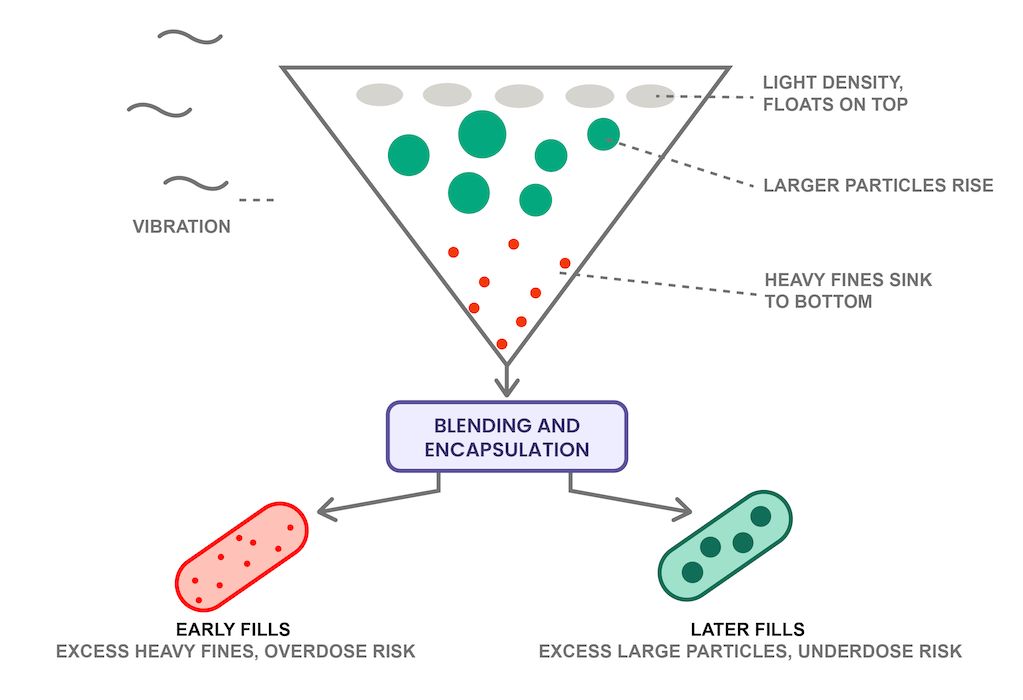
Powder segregation is the separation of components that were previously mixed together.
A simple example helps explain why this matters.
Imagine a blend containing larger particles and much smaller particles. Under certain conditions, the smaller particles can move through spaces between larger particles as the powder is handled or vibrated.
The ingredients have not changed.
Their physical arrangement has.
For a supplement brand, that means blend uniformity needs to be considered across the manufacturing process—not only at the moment blending is completed.
What Causes Powder Segregation During Capsule Manufacturing?
There is no single cause of powder segregation.
A formulation behaves as a physical system, and several properties can influence whether its ingredients remain distributed during manufacturing.
Particle Size Differences
Particle-size distribution is one of the most important considerations.
If ingredients in a blend have very different particle sizes, movement can create opportunities for smaller particles to move differently from larger ones.
Under suitable conditions, smaller particles may work their way through spaces between larger particles. This is sometimes described as sifting or percolation segregation.
That does not mean every formula requires every ingredient to be reduced to exactly the same particle size.
It means large or problematic differences in particle characteristics may need to be understood and managed.
For a brand owner, the useful question is:
Does the manufacturer evaluate particle-size differences before commercial production?
Density, Flow, and Other Powder Properties
Particle size is not the only variable.
Segregation behavior can also be influenced by differences in:
- bulk density;
- particle shape;
- cohesiveness;
- fines content;
- friction;
- and powder flow.
Bulk density describes how much powder mass occupies a given bulk volume.
Powder flow describes how readily and consistently the material moves through the manufacturing process.
These properties interact.
That is why a manufacturer should not look at one number, identify one difference, and assume it has explained the entire problem.
The powder needs to be evaluated as a system.
Why Commercial Encapsulation Can Expose the Problem
A formula may look manageable during development and behave differently once the manufacturing environment changes.
Commercial production introduces additional:
- powder transfer;
- feeding;
- movement;
- vibration;
- machine interaction;
- and longer production runs.
Those conditions do not automatically cause segregation.
But they can expose a blend’s existing tendency to separate.
Capsule-filling equipment itself can also influence what happens inside the powder bed as material is moved and fed during production.
This is one reason scale-up should not be treated as simply:
“We made a small amount successfully, so now we make more.”
In PureNSM’s manufacturing experience, some difficult blends that appear manageable on slower or gentler equipment can reveal additional flow or segregation challenges when moved to commercial automatic encapsulation.
The issue is not that automatic encapsulation is inherently bad.
Commercial production is necessary for scale.
The question is whether the powder has been properly evaluated for the conditions it will actually encounter.
Powder Flow and Powder Segregation Are Not the Same Problem
These two issues are often discussed together, but they are not interchangeable.
Powder flow asks:
How easily and consistently does the powder move through the process?
Powder segregation asks:
Do the different components of the blend remain distributed as the powder moves?
A formulation may experience:
- poor flow without significant segregation;
- segregation while still appearing to flow adequately;
- or both problems at the same time.
Why does the distinction matter?
Because the solution depends on the actual problem.
Poor flow can affect how consistently material feeds into capsule-filling equipment and may contribute to fill-weight variation.
Segregation, meanwhile, concerns whether the composition of the powder remains sufficiently uniform.
A manufacturer needs to diagnose what is actually happening before deciding how to change the process.
Otherwise, a brand may spend time and money trying to fix the wrong problem.
The Solution Starts Before the Powder Reaches the Encapsulation Machine
This is the part supplement brands should pay close attention to.
The time to think about powder behavior is not only after a commercial run develops problems.
It starts before encapsulation.
A manufacturer may need to evaluate characteristics such as:
- particle-size distribution;
- density;
- flow;
- cohesiveness;
- blend behavior;
- and how the material is likely to respond to handling and feeding.
Then comes the more important decision:
Does the powder actually need conditioning—and if so, what kind?
This is where process experience matters.
The “secret ingredient” is not necessarily another ingredient.
Sometimes the important variable is the process used to prepare the powder for manufacturing.
PureNSM’s current powder-conditioning capabilities include roller compaction, wet granulation, milling, automatic sifting, particle-size management, and flow optimization. PureNSM’s stated approach is to evaluate the powder first and apply the conditioning appropriate to the material rather than automatically using the same treatment for every formula.
That distinction matters.
The equipment itself is not the strategy.
Knowing when the equipment is needed is.
What Powder Conditioning Can—and Cannot—Do
Powder conditioning refers to processes used to change how a powder behaves during manufacturing.
Different approaches solve different problems.
Dry Granulation / Roller Compaction
Dry granulation can combine smaller powder particles into larger granules without using a liquid-granulation step.
Depending on the formulation, that may help modify:
- particle characteristics;
- density;
- flow behavior;
- and handling properties.
PureNSM’s current manufacturing materials identify roller compaction as one of its available powder-conditioning processes.
Wet Granulation
Wet granulation uses a controlled liquid-based process to bring powder particles together into larger granules.
For suitable formulations, granulation can help reduce the tendency of individual components to move independently of one another.
It is one possible manufacturing response—not a universal solution.
PureNSM also lists wet granulation among its current powder-conditioning capabilities.
Milling
Milling can be used to adjust particle characteristics when the material or process requires it.
The objective should not be “make everything as small as possible.”
The objective is to create physical characteristics that better support the intended manufacturing process.
Sifting
Sifting can help manage particle-size fractions as part of a broader powder-conditioning process.
Again, its usefulness depends on the material.
A manufacturer should be able to explain why a process is being used—not simply tell the brand that every formula receives the same treatment.
Why Granulation Can Help in the Right Formula?
Granulation deserves special attention because it can change how particles interact with one another.
In an appropriate formulation, bringing smaller particles together into more stable granules can reduce opportunities for individual components to separate independently during downstream handling.
But granulation should not be treated as a guaranteed fix.
A manufacturer still needs to consider:
- what is causing the segregation risk;
- whether the ingredients tolerate the selected process;
- what physical characteristics need to change;
- and what the formula requires after conditioning.
That leads to a better buyer question than:
“Do you have a granulator?”
Ask:
“How do you decide whether my formula actually needs granulation?”
Equipment ownership shows capability.
The explanation behind the decision shows expertise.
Testing Can Confirm a Problem, but It Does Not Replace Process Control
Testing is important.
But testing after production is not the same thing as controlling the process that produced the batch.
If a finished product does not meet the expected specification, the manufacturer still needs to understand why.
Was the issue:
- poor flow?
- segregation?
- filling behavior?
- raw-material variation?
- another process condition?
Testing can help reveal whether specifications are being achieved.
It does not replace understanding what happens to the powder before and during encapsulation.
For a brand owner, the better conversation is therefore not only:
“How do you test the finished capsules?”
It is also:
“How do you evaluate and control the process before the finished capsules are produced?”
Discovering a problem after a commercial run may mean:
- troubleshooting;
- rework;
- process adjustments;
- additional development;
- delays;
- and higher cost.
Evaluating manufacturability earlier can help reduce avoidable surprises.
What to Ask an Encapsulation Manufacturer Before You Choose One
Before selecting a manufacturer for commercial capsule production, ask questions that reveal how they think about the powder—not only their filling capacity.
Ask:
- How do you evaluate whether my powder blend is likely to segregate during commercial encapsulation?
- Which physical powder properties do you examine before production?
- How do particle-size and density differences affect your process decisions?
- How do you distinguish poor powder flow from blend segregation?
- What happens if my formula behaves differently at commercial scale than it did during development?
- Do you have granulation, milling, and sifting capabilities available in-house?
- How do you determine whether powder conditioning is actually necessary?
- What options do you have if the blend does not remain sufficiently uniform during processing?
- How do you verify that the manufacturing process is producing acceptable consistency?
- Which powder-conditioning steps are performed in-house and which, if any, are outsourced?
These questions tell you much more than:
“How many capsules can your machine fill per hour?”
Machine speed matters commercially.
But manufacturing preparedness matters first.
Frequently Asked Questions
What is powder segregation in capsule manufacturing?
Powder segregation occurs when components that were previously mixed begin separating during handling or processing. Differences in particle size, density, flow behavior, and process conditions can contribute depending on the formulation.
Is poor powder flow the same as powder segregation?
No. Powder flow describes how readily material moves through equipment. Powder segregation describes whether different components remain distributed within the blend. A formulation can experience one problem, the other, or both.
Can vibration cause powder segregation?
Vibration can contribute to segregation in susceptible powder blends, particularly when physical differences between particles allow them to move differently. The effect depends on the formulation and manufacturing conditions.
Can granulation reduce powder segregation?
Granulation can help reduce segregation risk in suitable formulations by changing how particles are physically associated and behave during processing. It is not a universal solution, so the manufacturer should first evaluate what is causing the problem.
Why can a powder behave differently at a commercial scale?
Commercial manufacturing can introduce additional transfer, feeding, vibration, machine interaction, and longer processing conditions. Those changes can reveal flow or segregation tendencies that were less obvious during smaller-scale work.